
Lesson guide
Learning objectives
- Explain the main purpose of Prototype methods, objects without proto in JavaScript.
- Identify the syntax, APIs, or concepts introduced in this lesson.
- Use the examples to predict how JavaScript will behave before you run similar code.
- Connect this topic to nearby lessons in Prototypes, inheritance.
Real-world context
This lesson matters when you need to recognize where Prototype methods, objects without proto fits into real JavaScript programs. In the first chapter of this section, we mentioned that there are modern methods to setup a prototype.
Key ideas
- Prototype methods, objects without proto is part of the Prototypes, inheritance chapter, so it builds on the surrounding concepts rather than standing alone.
- Read each code example in two passes: first for the result, then for the rule that explains the result.
- When a section compares similar features, focus on the condition that makes you choose one feature over another.
Key terms
- Prototype methods, objects without proto
- Prototype
- methods
- objects
- without
In the first chapter of this section, we mentioned that there are modern methods to setup a prototype.
Setting or reading the prototype with obj.__proto__ is considered outdated and somewhat deprecated (moved to the so-called “Annex B” of the JavaScript standard, meant for browsers only).
The modern methods to get/set a prototype are:
- Object.getPrototypeOf(obj) – returns the
[[Prototype]]ofobj. - Object.setPrototypeOf(obj, proto) – sets the
[[Prototype]]ofobjtoproto.
The only usage of __proto__, that’s not frowned upon, is as a property when creating a new object: { __proto__: ... }.
Although, there’s a special method for this too:
- Object.create(proto[, descriptors]) – creates an empty object with given
protoas[[Prototype]]and optional property descriptors.
For instance:
let animal = {
  eats: true
};

// create a new object with animal as a prototype
let rabbit = Object.create(animal); // same as {__proto__: animal}

alert(rabbit.eats);

alert(Object.getPrototypeOf(rabbit) === animal);

Object.setPrototypeOf(rabbit, {}); // change the prototype of rabbit to {}
The Object.create method is a bit more powerful, as it has an optional second argument: property descriptors.
We can provide additional properties to the new object there, like this:
let animal = {
  eats: true
};

let rabbit = Object.create(animal, {
  jumps: {
    value: true
  }
});

alert(rabbit.jumps); // true
The descriptors are in the same format as described in the chapter Property flags and descriptors.
We can use Object.create to perform an object cloning more powerful than copying properties in for..in:
let clone = Object.create(
  Object.getPrototypeOf(obj), Object.getOwnPropertyDescriptors(obj)
);
This call makes a truly exact copy of obj, including all properties: enumerable and non-enumerable, data properties and setters/getters – everything, and with the right [[Prototype]].
Brief history
There’re so many ways to manage [[Prototype]]. How did that happen? Why?
That’s for historical reasons.
The prototypal inheritance was in the language since its dawn, but the ways to manage it evolved over time.
- The
prototypeproperty of a constructor function has worked since very ancient times. It’s the oldest way to create objects with a given prototype. - Later, in the year 2012,
Object.createappeared in the standard. It gave the ability to create objects with a given prototype, but did not provide the ability to get/set it. Some browsers implemented the non-standard__proto__accessor that allowed the user to get/set a prototype at any time, to give more flexibility to developers. - Later, in the year 2015,
Object.setPrototypeOfandObject.getPrototypeOfwere added to the standard, to perform the same functionality as__proto__. As__proto__was de-facto implemented everywhere, it was kind-of deprecated and made its way to the Annex B of the standard, that is: optional for non-browser environments. - Later, in the year 2022, it was officially allowed to use
__proto__in object literals{...}(moved out of Annex B), but not as a getter/setterobj.__proto__(still in Annex B).
Why was __proto__ replaced by the functions getPrototypeOf/setPrototypeOf?
Why was __proto__ partially rehabilitated and its usage allowed in {...}, but not as a getter/setter?
That’s an interesting question, requiring us to understand why __proto__ is bad.
And soon we’ll get the answer.
Don’t change [[Prototype]] on existing objects if speed matters
Technically, we can get/set [[Prototype]] at any time. But usually we only set it once at the object creation time and don’t modify it anymore: rabbit inherits from animal, and that is not going to change.
And JavaScript engines are highly optimized for this. Changing a prototype “on-the-fly” with Object.setPrototypeOf or obj.__proto__= is a very slow operation as it breaks internal optimizations for object property access operations. So avoid it unless you know what you’re doing, or JavaScript speed totally doesn’t matter for you.
"Very plain" objects
As we know, objects can be used as associative arrays to store key/value pairs.
…But if we try to store user-provided keys in it (for instance, a user-entered dictionary), we can see an interesting glitch: all keys work fine except "__proto__".
Check out the example:
let obj = {};

let key = prompt("What's the key?", "__proto__");
obj[key] = "some value";

alert(obj[key]); // [object Object], not "some value"!
Here, if the user types in __proto__, the assignment in line 4 is ignored!
That could surely be surprising for a non-developer, but pretty understandable for us. The __proto__ property is special: it must be either an object or null. A string can not become a prototype. That’s why assigning a string to __proto__ is ignored.
But we didn’t intend to implement such behavior, right? We want to store key/value pairs, and the key named "__proto__" was not properly saved. So that’s a bug!
Here the consequences are not terrible. But in other cases we may be storing objects instead of strings in obj, and then the prototype will indeed be changed. As a result, the execution will go wrong in totally unexpected ways.
What’s worse – usually developers do not think about such possibility at all. That makes such bugs hard to notice and even turn them into vulnerabilities, especially when JavaScript is used on server-side.
Unexpected things also may happen when assigning to obj.toString, as it’s a built-in object method.
How can we avoid this problem?
First, we can just switch to using Map for storage instead of plain objects, then everything’s fine:
let map = new Map();

let key = prompt("What's the key?", "__proto__");
map.set(key, "some value");

alert(map.get(key)); // "some value" (as intended)
…But Object syntax is often more appealing, as it’s more concise.
Fortunately, we can use objects, because language creators gave thought to that problem long ago.
As we know, __proto__ is not a property of an object, but an accessor property of Object.prototype:
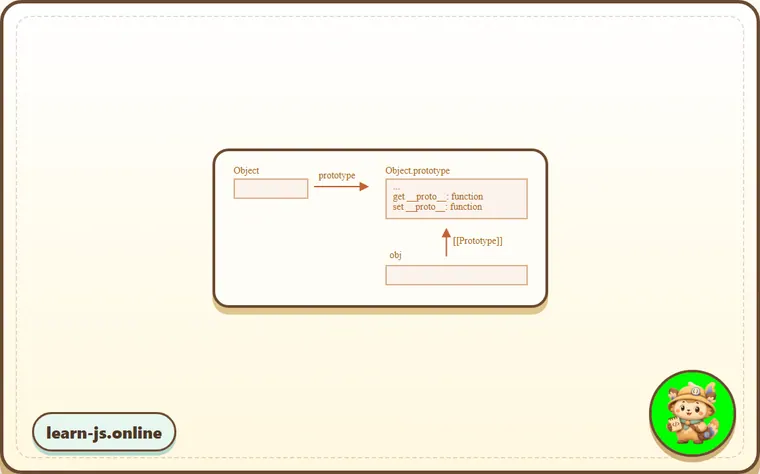
So, if obj.__proto__ is read or set, the corresponding getter/setter is called from its prototype, and it gets/sets [[Prototype]].
As it was said in the beginning of this tutorial section: __proto__ is a way to access [[Prototype]], it is not [[Prototype]] itself.
Now, if we intend to use an object as an associative array and be free of such problems, we can do it with a little trick:
let obj = Object.create(null);
// or: obj = { __proto__: null }

let key = prompt("What's the key?", "__proto__");
obj[key] = "some value";

alert(obj[key]); // "some value"
Object.create(null) creates an empty object without a prototype ([[Prototype]] is null):
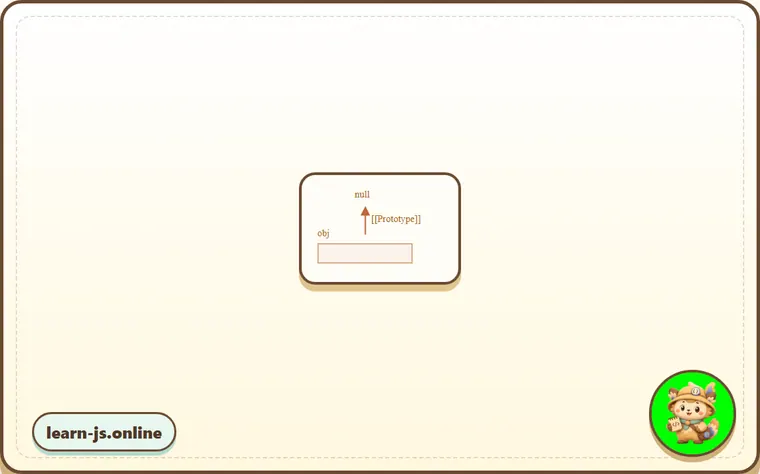
So, there is no inherited getter/setter for __proto__. Now it is processed as a regular data property, so the example above works right.
We can call such objects “very plain” or “pure dictionary” objects, because they are even simpler than the regular plain object {...}.
A downside is that such objects lack any built-in object methods, e.g. toString:
let obj = Object.create(null);

alert(obj); // Error (no toString)
…But that’s usually fine for associative arrays.
Note that most object-related methods are Object.something(...), like Object.keys(obj) – they are not in the prototype, so they will keep working on such objects:
let chineseDictionary = Object.create(null);
chineseDictionary.hello = "你好";
chineseDictionary.bye = "再见";

alert(Object.keys(chineseDictionary)); // hello,bye
Common mistakes
- Skipping the small examples and then missing the exact rule that Prototype methods, objects without proto depends on.
- Copying code without changing one value at a time to see which part controls the result.
- Treating similar-looking syntax or APIs as interchangeable before checking their edge cases.
Summary
-
To create an object with the given prototype, use:
- literal syntax:
{ __proto__: ... }, allows to specify multiple properties - or Object.create(proto[, descriptors]), allows to specify property descriptors.
- literal syntax:
The Object.create provides an easy way to shallow-copy an object with all descriptors:
let clone = Object.create(Object.getPrototypeOf(obj), Object.getOwnPropertyDescriptors(obj));
-
Modern methods to get/set the prototype are:
- Object.getPrototypeOf(obj) – returns the
[[Prototype]]ofobj(same as__proto__getter). - Object.setPrototypeOf(obj, proto) – sets the
[[Prototype]]ofobjtoproto(same as__proto__setter).
- Object.getPrototypeOf(obj) – returns the
-
Getting/setting the prototype using the built-in
__proto__getter/setter isn’t recommended, it’s now in the Annex B of the specification. -
We also covered prototype-less objects, created with
Object.create(null)or{__proto__: null}.
These objects are used as dictionaries, to store any (possibly user-generated) keys.
Normally, objects inherit built-in methods and __proto__ getter/setter from Object.prototype, making corresponding keys “occupied” and potentially causing side effects. With null prototype, objects are truly empty.
Predict
Before running this prototype-methods check, predict the seven output lines. It uses Object.create, descriptor-based properties, getPrototypeOf, setPrototypeOf, and a dictionary object with no prototype.
Reveal explanation
The output is true, true, jumps, undefined, true, stored value, and __proto__,toString. Object.create(animal, descriptors) creates rabbit with animal as its prototype and an own enumerable jumps property. After Object.setPrototypeOf(rabbit, { runs: true }), lookup no longer reaches animal, so rabbit.eats becomes undefined, while rabbit.runs is inherited. Object.create(null) creates a dictionary with no Object.prototype, so __proto__ and toString are stored as ordinary keys.
Try it
Replace Object.create(null) with {}, then predict why assigning dictionary["__proto__"] no longer behaves like normal data storage.
Practice
- Rewrite one example from this lesson without looking at the original, then run it and compare the result.
- Change one input, operator, method call, or option in a code sample and predict what will happen before running it.
- Explain Prototype methods, objects without proto in your own words as if you were reviewing it with another learner.
Keep learning
Continue with Class basic syntax when you are ready for the next lesson.